MPS Parents, YES, and MTEA Issue Joint Letter on Budget to MPS Board and Office of Accountability & Efficiency
April 6, 2026
April 6, 2026
To the Milwaukee Public School Board Directors and MPS Office of Accountability and Efficiency,
As MPS students, parents and public education workers, we write out of deep concern for the current direction of Milwaukee Public Schools under existing leadership. Across the district, we are observing consistent breakdowns in planning, transparency, and stakeholder engagement that are destabilizing schools and eroding trust. These leadership failures are not abstract – they are directly shaping current budget decisions that reduce critical student supports while maintaining or expanding less essential expenditures. We write to ensure the full Board has insight into how these patterns are materially impacting the district’s financial priorities and, ultimately, student outcomes.
Lack of Strategy, Alignment, Transparency and Collaboration Leads to Chaos, Confusion and Cuts to Critical Student Supports and Services
Over the past year, there has been a significant shift in how decisions are developed, communicated, and implemented across the district. While there has been frequent messaging around “strategy,” “alignment,” “transparency,” and “collaboration,” current practices do not reflect these values. There is a growing disconnect between what is being communicated by the Superintendent and what is actually occurring in practice on the ground in our schools.
At present, there is not a clearly articulated, documented, or shared strategic plan that defines district priorities, guides resource allocation, or establishes how major initiatives will be implemented, measured, and sustained. In the absence of such a framework, budget decisions are being made without a transparent rationale for how resources are prioritized across competing needs. This has resulted in reductions to student-facing positions – including teachers, paraprofessionals, and support staff – without a clear explanation of how these cuts align with district goals or student outcomes and without meaningful engagement with MTEA and ASC.
At the same time, significant expenditures outside of direct school support – including administrative expansion and external consultant contracts – have continued or increased. The contrast between reductions in classroom and student services and sustained or growing central and contracted spending raises serious concerns about the district’s budget priorities and fiscal stewardship.
This has created a pattern where expectations are set at the highest level in our organization, but the operational “how” is unclear and left to individual schools and departments to determine on their own. There appears to be very limited accountability for execution, as there is no shared understanding of what success looks like or how it will be measured by the Superintendent.
This lack of clarity and alignment is particularly evident in recent system-level changes, including the “Standard of Care” (SOC) class size expectations and the rollout of centralized budgeting across all our schools have been advanced without the level of planning, transparency, and stakeholder engagement typically required for changes of this scale. These are significantly complex initiatives that, in comparable districts, require extensive planning, authentic, good faith meet and confer with MTEA and ASC, stakeholder engagement, board approval and phased implementation. In our case, they have been executed without that foundation resulting in individual schools being required to make high-stakes budget decisions without clear guidance, consistent assumptions, or a shared understanding of desired outcomes. The downstream effect is confusion among principals, district leaders, frontline educators and staff, decreased productivity, increased operational burden at the school level, and erosion of trust with key stakeholders.
Additionally, there is a growing concern that what is being presented as “collaboration” does not reflect meaningful engagement. Input from principals, educators, and school communities has not been systematically incorporated into decision-making, leading to allocations that do not reflect the operational realities or specific needs of individual schools. Take for example the case of Student Engagement Councils (SECs) – the chaotic centralized budget process has limited meaningful input from key stakeholders despite district policy outlining their advisory role. SEC members report they were not provided sufficient information or time to review or influence key decisions prior to being asked to approve them. This process effectively shut out key stakeholders MPS policy says should have a voice. Some SEC representatives have gone so far as to abstain from signing budget forms in protest.
Nor do they reflect the will of the community – The board is being misled when you are told collaboration existed with our SOC and centralized budget processes. Input from principals, school leaders, and staff has not been systematically gathered, incorporated, or reflected in decisions in the least.
This pattern is now evident within MPS and is contributing to the misalignment, lack of stakeholder engagement, and operational instability that we are experiencing across the entire district. You must know that this is happening in real time and is causing ever increasing destabilization for MPS families, students and workers.
For MPS students, the Superintendent’s recent cuts to classroom positions have resulted in us losing beloved art, music, physical education, technology, and finance teachers. Our school counselors, paraprofessionals and Children’s Health Assistants are having their hours reduced or their positions are being cut entirely from our schools. These dangerous decisions make our schools less safe. They not only limit our access to a well-rounded education but put vital, legally mandated services in jeopardy for our highest needs students with special needs. Additionally, the Superintendent’s refusal to give all frontline workers a full 2.63% cost of living adjustment on July 1, 2026 disrespects the dedicated staff we do have and must retain. In a district already facing significant brain drain and hundreds of vacancies, these decisions only push more of our most qualified educators and staff to leave.
Parents are seeing critical staff that are a part of our children’s school community cut without clear or coherent rationale that, in many cases, does not align with increasing enrollment needs or the unique needs of each school community. Decisions of this magnitude require transparency and careful, meaningful deliberation. The Superintendent choosing to introduce this process so late in the year while framing it as the only option demonstrates her disregard for dedicated MPS parents and families.
For frontline education workers, the Superintendent’s actions since she began last year demonstrate a pattern of disrespect, chaos, lies and poor planning. This was first demonstrated last spring when the superintendent forced over 100 teachers into a chaotic and insulting process to reapply and reinterview for their positions and has only continued since. Despite the Superintendent telling the Board, the public and staff that she is not going to cut classroom-facing positions, many educators received letters the week before Spring Break that revealed they would be cut completely from their schools or have their hours reduced. Art, music and physical teachers, personal finance and technology teachers, school counselors, paraprofessionals and Children’s Health Assistants are all seeing their hours reduced or cut entirely from their schools. These cuts betray not just MPS students who will be most directly impacted but all Milwaukee voters who voted yes in two recent referendums to ensure that students in classrooms would be prioritized and fully staffed. Meanwhile, the Superintendent continues to refuse to give frontline workers a full cost of living adjustment next school year despite more than 3,600 educators, parents and community members signing onto a petition calling on her to do just that. In addition, seven area community and labor organizations have written letters in favor of MPS giving a full COLA to all frontline workers, including the Amalgamated Transit Union Local 998, the Milwaukee Area Labor Council, Alderman Alex Brower, and AFSCME Local 47. The Superintendent claims she cannot afford it given MPS’s budget deficit. However this argument fails to bear weight given that she has:
- Failed to examine all MPS contracts worth hundreds of millions of dollars.
- More than doubled the size of highly paid administrators in her cabinet.
- Given raises of between $30,000 and $70,000 to 26 central office administrators since September 2025.
- Hired a steady stream of private consultants for pet projects.
- Increased all principals to twelve month contracts.
- In December, continued the practice of spending millions in pay outs to Central Office Administrators who allegedly didn’t use their vacation, with millions more slated to be paid out in June.
For administrators, the Superintendent’s chaotic rollout of her flawed centralized budgeting process has caused school leaders to make significant staffing and programming decisions without the clarity required to do so responsibly. The Administrators and Supervisors Council (ASC) and Milwaukee Teachers’ Education Association (MTEA) warned the Board about this process in a joint letter sent on March 6. Since then, the Superintendent has adopted a uniform and highly problematic assistant principal staffing ratio of one assistant principal for every 350 students that fails to account for differences in school structure, student need and program complexity. Families report that the loss of an assistant principal would have immediate consequences for school climate, safety and daily operations. To add insult to injury, to maintain employment in MPS, these assistant principals have to reapply for positions with their seniority reset to zero, effectively erasing years of service and creating instability for experienced staff.
Concerning Contract Decisions
(Letter received by the Board and Office of Accountability and Efficiency on Monday, 3/30.)
Additionally, as key MPS stakeholders, we are gravely concerned about the Superintendent’s steady stream of private consultants she’s using for pet projects. Recent board materials confirm that Milwaukee Public Schools has approved a $250,000 contract with 4MATIV Technologies for transportation analysis and optimization. Mary Dillman, former Chief of Staff to Superintendent Brenda Cassellius currently works at 4MATIV as their Chief of Client Services. This contract follows a prior $48,000 transportation study conducted in August, and was executed without a Milwaukee-specific competitive bidding process, instead relying on a cooperative purchasing mechanism.
This sequence raises both procurement integrity concerns and a conflict-of-interest issue that warrants direct Board oversight. The Superintendent’s prior professional relationship with the vendor – combined with the decision to initiate work through a sub-$50,000 contract and expand it into a substantially larger engagement without open competition – creates at minimum the appearance of preferential access and reduced vendor neutrality. In public-sector governance, even the appearance of such a conflict is significant and requires transparency and independent review.
The procurement structure itself compounds this concern. By issuing an initial contract below the competitive bidding threshold, the district effectively established a single vendor as the incumbent. That vendor then gained access to district data, internal systems, and decision-making context, positioning them to secure the subsequent $250,000 contract as a continuation of prior work. In practice, this creates a de facto sole-source procurement pathway for a high-cost, high-impact contract, limiting meaningful competition and independent evaluation.
In addition, separate board materials indicate that this same vendor is engaged in enrollment and scenario modeling work, influencing projections of school utilization, capacity, and long-term district planning. These analyses directly inform decisions about staffing reductions, school restructuring, and transportation changes.
It is also important to note that firms operating in this space – including 4MATIV – typically rely on proprietary models and internally developed assumptions that are not independently validated or publicly benchmarked. In other districts, transportation optimization efforts of this kind have led to controversial outcomes, including longer ride times, service changes, and community disruption. This underscores the risk of relying on vendor-driven analysis to guide high-stakes public decisions without independent verification, particularly when that vendor was engaged through a non-competitive pathway.
At the same time, enrollment trends have been presented to families in a manner that emphasizes decline as inevitable, without transparent modeling of alternative scenarios such as retention strategies or programmatic investments. This creates a closed policy loop in which:
- Enrollment projections establish a narrative of decline;
- Consultant models identify “efficiencies” and underutilized capacity;
- Resulting recommendations inform staffing cuts and operational changes.
Taken together, these factors raise serious concerns regarding transparency, methodology, fiscal stewardship, and governance, particularly as the district advances significant reductions to frontline, school-based staff.
Call for Leadership and Accountability
The cumulative impact of these decisions is not simply frustration, it is organizational destabilization and a continuing decline of staff morale. There is a growing risk of increased turnover among key frontline education workers and administrators who are essential to the success of this district.
To right the ship, MPS administration must be held accountable. MPS has strongly committed families, students, educators and leaders. With the right alignment and leadership approach, the district can move forward successfully. However, many of you are not being provided a full and accurate picture by the Board President and Superintendent. The current trajectory presents serious risks that warrant your immediate attention. To that end, we are calling on the School Board to schedule a Special Board meeting as soon as possible in April to direct the Superintendent to do the following:
- Reverse the superintendent’s cuts by maintaining or increasing hours for critical frontline staff, including paraprofessionals and children’s health assistants, art, music, and physical education teachers, school counselors, school social workers, school nurses, psychologists and librarians.
- Direct the Superintendent to stabilize MPS’s workforce in school classrooms by agreeing to a full 2.63% cost-of-living adjustment for all MTEA workers on July 1, 2026.
- Give principals the autonomy to restore previous staffing levels.
- Pause the implementation of the Superintendent’s haphazard and harmful centralized budgeting process that fails to meet the unique needs of each school community. Utilize spring, summer, and fall 2026 to give the school budgeting process the care and time required to engage in careful, system level change analysis, with extensive planning and impact analysis, meaningful engagement with the families of all 139 public schools, collaboratively meet and confer with MTEA and ASC to develop a proposal that would go to the board for approval.
- Conduct a thorough review of personnel cost and growth in Central Office and consultant expenditures since March 2025 to current.
- Ensure greater transparency and oversight in procurement practices and budget development.
Sincerely,
Youth Empowered in the Struggle
Milwaukee Teachers’ Education Association
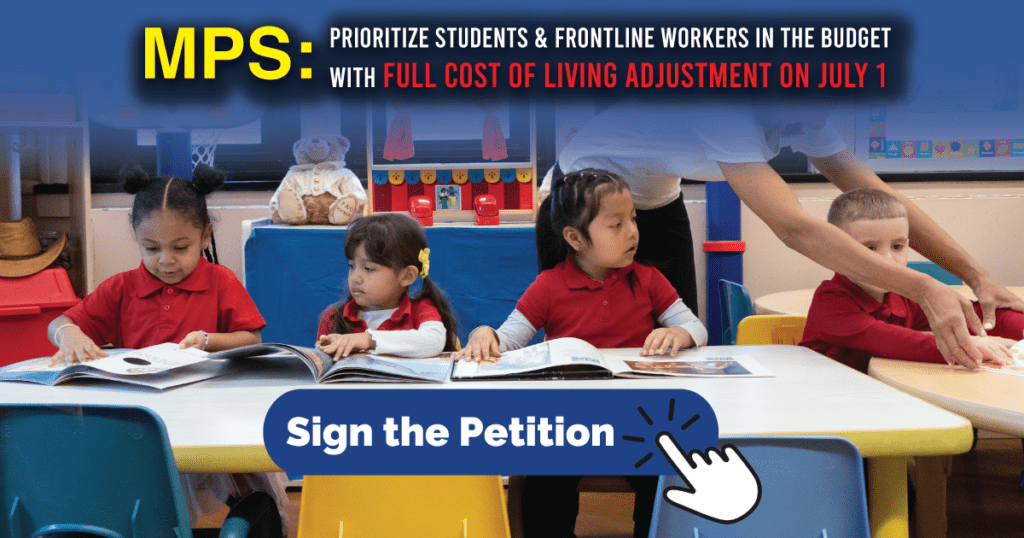
PLEASE SIGN OUR PETITION IN SUPPORT OF FRONTLINE WORKERS AND STUDENTS